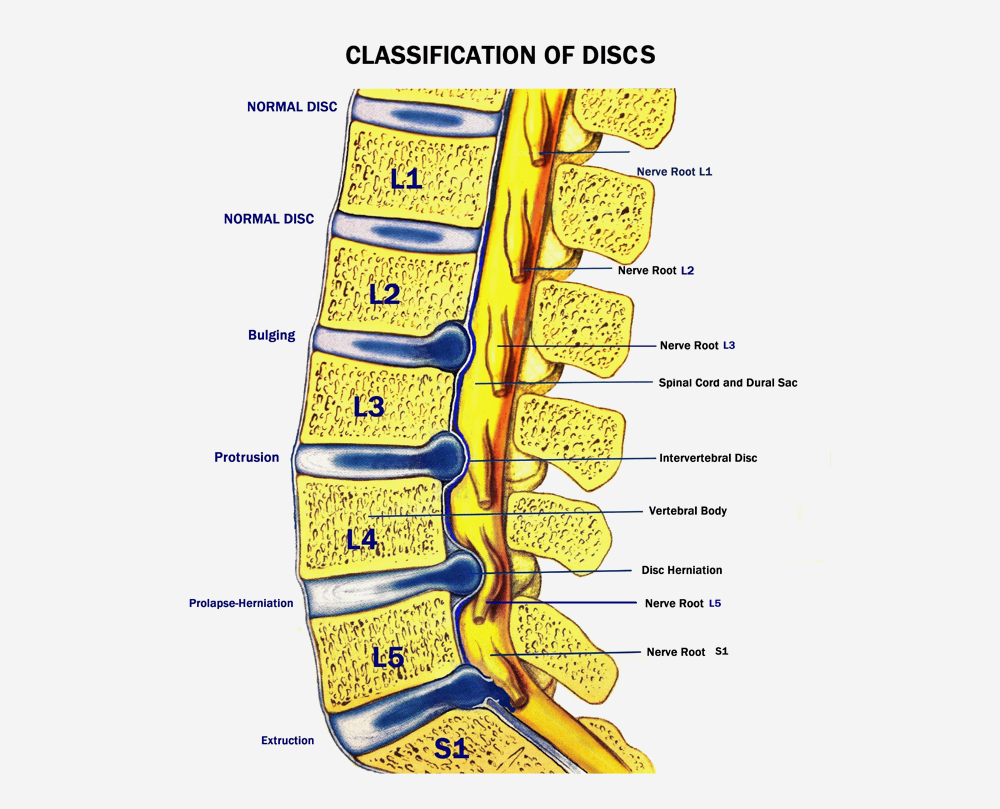
What are spinal discs? Disc is a cushion between vertebra and provide shock absorption, protecting the spinal cord and ensuring flexibility of the spine. Weight is transmitted through vertebral column and thus through disc. Disc is made up of inner circular nucleus pulposus and outer annulus fibrosis. Nucleus pulposus is soft and thick gelatinous substance. Central nucleus pulposus expands with pressure and helps to absorb the shocks during weight transmission and movements of vertebral column. Lastly they act as a fulcrum to direct the type of movement through which each vertebra travels.
Accelerated pressure changes within disc and horizontal expansion of nucleus pulposus secondary to pressure results in disc bulge into annulus fibrosus. Annulus fibrosus is tough membrane and resist tear in healthy young individual. Illness such as disk degeneration weakens the fibrous annulus and disk bulge herniate through the torn or broken annulus fibrosus known as herniated disc. Lumbar disc herniation is observed in disc between L1 and S1 vertebra. Most common disc herniation is observed at level of L4/L5 and L5/S1 disc.
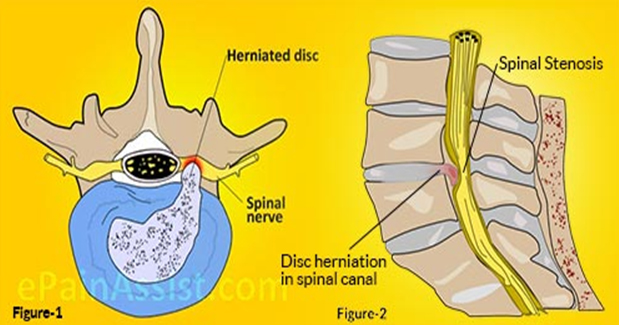
Disc herniates either into inter-vertebral foramina (figure 1) or spinal foramina (figure 2). Inter-vertebral foramina is a lateral bony tunnel meant to pass the spinal nerve and lumbar spinal canal accommodates lower end of spinal cord and quada equina. Disc herniation into inter-vertebral foramina causes pinch nerve pain or radicular pain. Large disk herniation into spinal canal causes narrowing of spinal canal or spinal stenosis (figure 2). Spinal stenosis causes pressure on spinal cord or quada equina resulting in quada equina syndrome.
What is stenosis?
Spinal stenosis is created by the narrowing of the spinal canal. This narrowing may be caused by mechanical problems or by abnormalities in the aging spine. It may or may not result in low-back pain, limping, and a lack of feeling in the legs. Stenosis is often a degenerative condition. It may exist for years without causing pain or discomfort, but a fall or an accident can trigger characteristic stenotic pain. Numerous factors can cause stenosis, such as thickened ligaments, expanding infection, abscess, a congenital or developmental anomaly, degenerative changes, vertebral fractures or dislocations, or a spinal cord tumor.
Since spinal discs have a very poor blood supply, they also depend upon the circulation of joint fluids to bring in nutrients and expel waste. If a spinal joint loses its normal motion and this pumping action in impaired, the health of the disc deteriorates. Like a wet sponge, a healthy disc is flexible. A dry sponge is hard, stiff, and can crack easily. This is how many disc problems begin. The chiropractic approach to disc problems is to help restore better motion and position to the spinal joints. Besides reducing disc bulging, better spinal function helps decrease inflammation so the slow process of healing the surrounding soft tissues can begin.
The most common disc problem suffered by adults is Degenerative Disc Disease. This occurs when the disc nucleus loses water and small tears develop in it. The body then forms osteophytes (bone spurs), along the edges of the vertebra and the disc space narrows. We used to believe that this was a function of “wear and tear” as we aged. The most recent evidence shows that, most often, there is a hereditary link to the development of degenerative disc disease. Degenerative disc disease can also be caused by trauma/injury.
Here is a list of other most common disc problems you may experience:
What are the common signs and symptoms of disc problems?
- Back or neck pain
- Leg or arm pain
- Stiffness
- Tenderness of the spine and spinal muscles
What Is The Vertebral Subluxation?
This occurs when the joints in your spine have limited range of motion. When the spinal bones move out of their normal position it is called a subluxation.
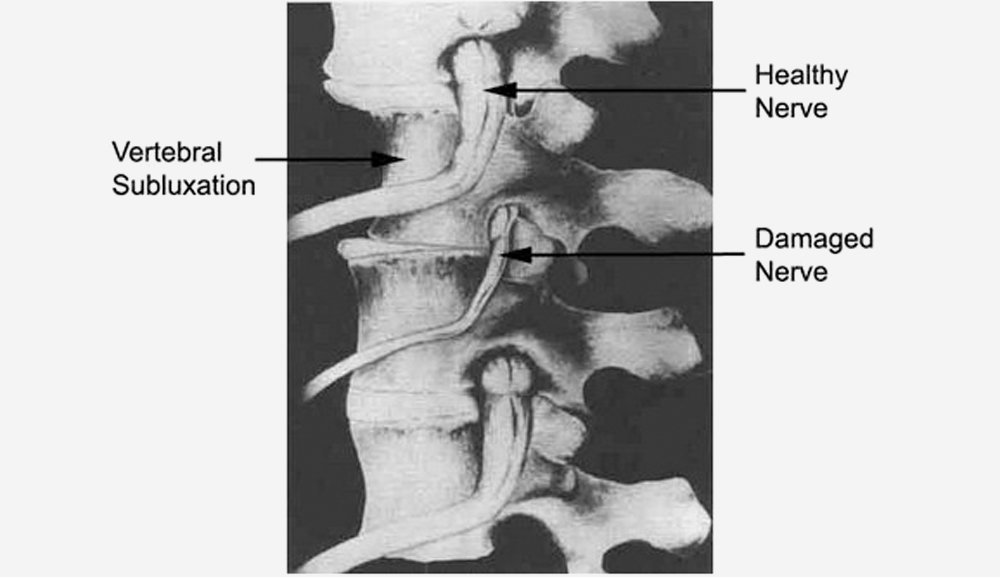
The spinal cord is the communication pathway for nerve impulses to and from the brain. These messages determine the health and function of virtually every cell, tissue, organ and system of the body. Vertebrae protect these nerves; even a small change in the position of the spinal bones can have a profound adverse affect on these delicate nerve tissues.
What is The Subluxation Degeneration?
Regardless of age, when spinal damage goes uncorrected, the body deposits calcium on the surface of adjacent bones that aren't moving properly. If neglected long enough, this splinting effect can result in complete fusion. This worsening process is called Subluxation Degeneration and can occur throughout the spine.
The VERTEBRAL SUBLUXATION COMPLEX
Chiropractors are remarkably unique in the health care field as they are the only health care professionals trained to detect and treat a condition referred to as the " Vertebral Subluxation Complex". Chiropractors have found vertebral subluxations to be responsible for and contribute to a number of spinal and extra-spinal disorders.
What Is The Subluxation Complex?
Through extensive research and study chiropractors have identified 5 components of the vertebral subluxation. Collectively, these elements are known as the "subluxation complex".
1. Kinesiopathology – the loss of normal vertebral positioning and motion in relation to neighboring vertebrae
2. Myopathology – pathological changes occurring in the spinal musculature which includes hypertonicity, spasming, fibrosis, weakness and improper or inappropriate functioning
3. Neuropathology – irritation or injury to spinal nerve roots through compression, stretch or more commonly chemical irritation from nearby spinal structures
4. Histopathology – pathological changes which occur to the spinal tissues such as abnormal bony growths off the vertebral bodies and joints, fibrosis and adhesions of spinal muscles and ligaments, as well as dehydration and degeneration of spinal discs
5. Pathophysiology – the biochemical changes taking place in the spinal region which include inflammatory biochemicals from injured tissues and biochemical waste products
Each component of the subluxation must be eliminated for proper healing to occur and for the rehabilitation process to be successful. While full understanding of all components is not necessary, you should be aware of the complexity involved. Patients should also be aware that pain is but a small element of most diseases and disorders. Pain is a very poor indicator of your need for further treatment as pain generally subsides well before tissue healing and mechanical normalization has completed.
What Causes Subluxations?
Vertebral subluxations have a great number of different causes all of which the average individual is exposed to daily. These causes can be described in terms of physical, chemical, and emotional causes.
Physical causes include acute trauma to the body, repetitive motions affecting the spine, bad postural habits, improper workstation habits and design, and weak or imbalanced spinal musculature.
Chemical causes include poor dietary and nutritional practices, drug and alcohol use and abuse, and the ingestion of chemical toxins in the foods we eat, air we breath, and water we drink. Chemicals which are harmful to the body decrease the body's ability to function optimally and reduce the ability to successfully adapt to and withstand internal and external stresses - making us more susceptible to spinal subluxations and the consequences of these subluxations.
Emotional causes refer to stress. Excessive stress or inadequate stress management skills can deplete the body of the ability to sustain normal functions. The impact of emotional stress on physical health is well documented in the medical research and can have devastating effects on the immune system, making the body susceptible to injury and disease.
How Are Subluxations Corrected?
Chiropractors learn a number of different chiropractic techniques and procedures to correct vertebral subluxations. Most of the procedures involve the application of a chiropractic spinal adjustment to the affected vertebrae.
Chiropractic adjustments involve the application of a quick but gentle corrective force into the "subluxated" spinal vertebrae. The adjustment can be delivered manually through the hands or can be applied through the use of a specialized tool. Subluxations generally require multiple treatments or adjustments for complete normalization to occur. Similar to straightening teeth, correcting malfunctioning and malaligned vertebrae requires time for the tissues to accept this new position as "normal".
How Can I Tell If I Have A Vertebral Subluxation?
The only accurate way to determine if you suffer from subluxations is to receive a chiropractic evaluation. However, a number of signs and symptoms are commonly associated with the vertebral subluxation and include:
- neck pain, tenderness, soreness and stiffness
- back pain, tenderness, soreness and stiffness
- headaches
- dizziness or balance problems
- spinal muscle spasm, tightness or weakness
- reduced spinal mobility
- pain, numbness or tingling in the extremities
- joint pain and stiffness
- low energy
- poor overall state of health
- poor tissue healing
Individuals who are not currently experiencing pain or other discomforts are not necessarily "subluxation free". As previously described, pain is a very poor indicator of disease processes, including the presence of subluxations. Subluxations are similar to cavities in that many times a significant amount of damage is present before symptoms such as pain are felt. This is why we recommend, like your dentist, that individuals seek periodic spinal evaluations to check for the presence of subluxations and other spinal abnormalities, even in the absence of pain.